Service Dog Graduates From Polytechnique After Five Years
Victor Bal and his Mira-trained service dog Kopeck walk the stage together, making history as one of the first ASD service dog partnerships to complete a university degree.
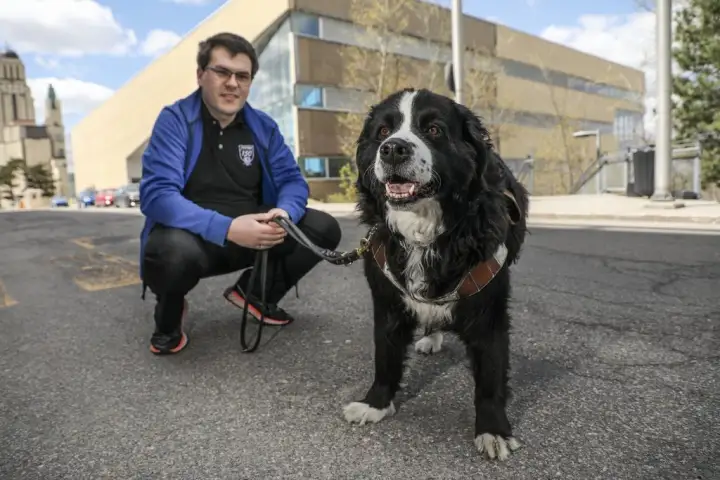
When Victor Bal crosses the stage at Polytechnique Montréal this month to collect his mechanical engineering degree, his service dog Kopeck will be by his side—a partnership that spans five years of classes, exams, and the quiet work of managing autism spectrum disorder in a demanding academic setting.
At 27, Bal is among the first Canadians to complete a university degree with an ASD service dog trained by the Mira foundation. Kopeck, an eight-year-old Labrador-Bernese Mountain Dog cross, has been his constant: present during lectures, in libraries, at home. The dog is trained to recognize signs of stress and respond—a nudge with her nose, a sound designed to ground Bal and pull him back to the present.
"She's my partner, she's my ally," Bal said. "Not long ago I called her my shield and sword to face the world, because she gave me the tools I need to be a working member of society and be the greatest version of myself."
Bal's path to graduation wasn't linear. He struggled through elementary and high school, nearly foundering. When he got his first service dog—Kopeck is his second—something shifted. The dog gave him something to care for, which meant caring for himself. He looked both ways crossing the street. His social skills sharpened. Self-esteem grew.
He took six years to finish high school, four for junior college, five for his degree. "It takes more time, but I did it and that's what matters," he said.
Marie-Michèle Vézina, an adviser for students with disabilities at Polytechnique, said Bal and Kopeck have become "champions" of accessibility across campus—their presence normalizing what once seemed extraordinary. More than 1,000 Polytechnique students now use accessibility services, up from 40 fifteen years ago.
When Bal removes Kopeck's harness—her signal to stop working—the dog runs and plays like any other. But in the classroom, at the library, walking across campus: she is entirely present. It's a model of partnership that says something powerful about what's possible when systems—dogs, universities, people—show up for one another.