Ontario's underground neutrino lab is world's largest cavity
Two kilometers below Sudbury sits the Sudbury Neutrino Observatory, a breakthrough science space that helped win a Nobel Prize.
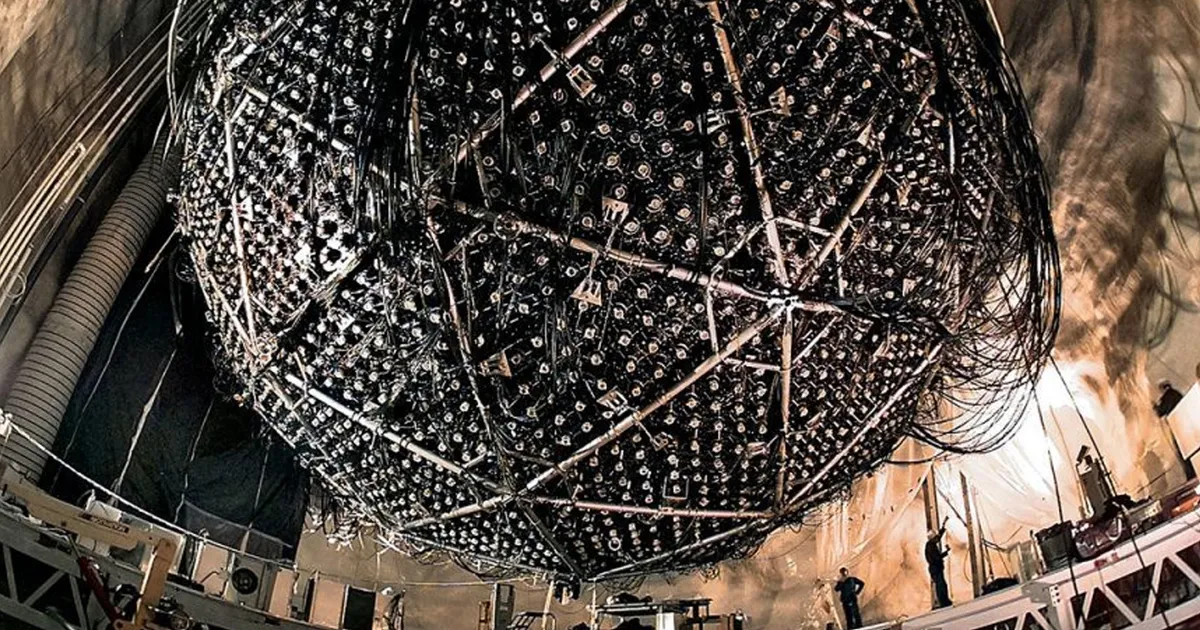
Hidden almost two kilometers beneath the surface near Sudbury sits one of Earth's strangest laboratories: the Sudbury Neutrino Observatory, a massive underground chamber carved directly into solid rock that's considered the world's largest human-made cavity at that depth.
Built inside a working mine, the observatory was designed to do something that sounds impossible — catch neutrinos, the ghost-like particles that constantly stream through the universe and barely interact with anything. Billions pass through your body every second without your noticing. To detect even a handful, scientists had to think radically.
The underground location itself was the breakthrough. Shielded from cosmic rays and background radiation that would drown out the signal, the massive spherical detector sat surrounded by thousands of light sensors. At its center was a giant tank of heavy water, a special isotope designed to interact with neutrinos when they collided with atoms. Even with all that machinery, researchers recorded only a handful of interactions per day.
Construction started in 1990; the first experiment ran in 1999. The work proved that neutrinos could change form while traveling through space — a finding so significant that in 2015, Canadian physicist Arthur B. McDonald shared the Nobel Prize in Physics partly for this work.
The observatory no longer operates in its original form, but the facility evolved into SNOLAB, now one of the world's leading underground science laboratories. The site isn't open for public tours, though the Science North museum in Sudbury displays exhibits about the project. It's a reminder that some of Canada's most important scientific infrastructure isn't visible from the surface.