Before the Bentway: photographer documents CBM Bathurst concrete plant's 1998 life
A concrete batching facility that supplied downtown Toronto from 1960 until its closure occupied fill land beside the Gardiner Expressway, serving as subject of a long-term industrial documentary.
The day's top stories, food & events — every morning at 7. Unsubscribe anytime.
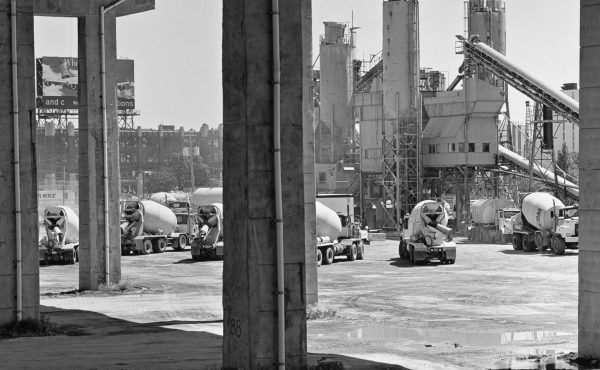
When photographer Spacing Toronto visited the foot of Bathurst Street in 1998, a small industrial complex sat in the flat plain southwest of Bathurst — the Canada Building Materials concrete batching plant known as CBM Bathurst, which dispatched ready-mixed concrete to downtown construction sites. The bent of the Gardiner Expressway, now the eastern entrance to the Bentway, framed an open vista westward toward Strachan Avenue and the plant beyond.
CBM Bathurst opened in 1960, the same year the Gardiner was driven past Bathurst on a path that detoured around Fort York. The plant was sited parallel to rail sidings connected to the Spadina freight yards to the east — a crucial advantage when rail transport was still being used to deliver aggregates from quarries and sand pits outside the city. The location itself was engineered: it occupied land the Toronto Harbour Commission had created before 1927 by filling in Lake Ontario with sewage sludge, excavated material from construction sites, silt dredged from the harbour bottom and municipal garbage.
In 1960, the neighbourhood was still primarily industrial. Neighbours to the south included the Molson Brewery on Fleet Street, Tip Top Tailors on Lakeshore Boulevard and the Canada Malting plant at the foot of Bathurst. Directly across from the CBM truck entrance sat the former Loblaws Groceteria manufacturing and warehousing complex, which after 1983 would be occupied by the Daily Bread Food Bank. North of the plant, a wedge of scrubby forest separated Fort York from the industrial area; an abandoned, overgrown rail spur ran through it. That spur has since been replaced by Fort York Boulevard and residential towers.
By 1998, the rail connection was long gone. CBM Bathurst received cement powder from the St Marys Cement plant in Bowmanville, crushed limestone from a quarry on the Niagara Escarpment near Acton, and fine aggregates from the Aberfoyle Pit south of Guelph — all delivered by truck at higher environmental cost than the earlier rail system. There were no fences around the batching plant, and its operations often expanded to fill the available space. The structure exemplifies what the industrial photographers Bernd and Hilla Becher called "anonymous sculpture" — one could imagine it as the bridge of a fantastic vessel that had remained moored in place during the filling in of the lake.
The plant operated by gravity feeds and conveyor belts. On arrival, aggregates were dumped into an underground hopper, from which they were conveyed to an elevated gallery and dropped into separate bunkers. A row of hoppers below the bunkers weighed out the aggregates, and conveyor systems moved materials through the plant. This photograph is part of a broader Concrete Industries project from 1998–2004, which aimed to depict the complete life cycle of an essential building material.
The details
When did the CBM Bathurst concrete plant operate?
The CBM Bathurst plant opened in 1960 and operated until its closure, which the article does not specify.
Where did CBM Bathurst source its materials by 1998?
By 1998, CBM Bathurst received cement powder from the St Marys Cement plant in Bowmanville, crushed limestone from a quarry on the Niagara Escarpment near Acton, and fine aggregates from the Aberfoyle Pit south of Guelph, all delivered by truck.
What was the site's history before the concrete plant?
The land was created by the Toronto Harbour Commission before 1927 through filling Lake Ontario with sewage sludge, excavated material from construction sites, harbour silt, and municipal garbage.
