Inside Alberta caves, scientists battle bat-killing fungus
Parks Canada teams are spreading bacteria to combat white-nose syndrome, a disease threatening the province's entire hibernating bat population.
The day's top stories, food & events — every morning at 7. Unsubscribe anytime.
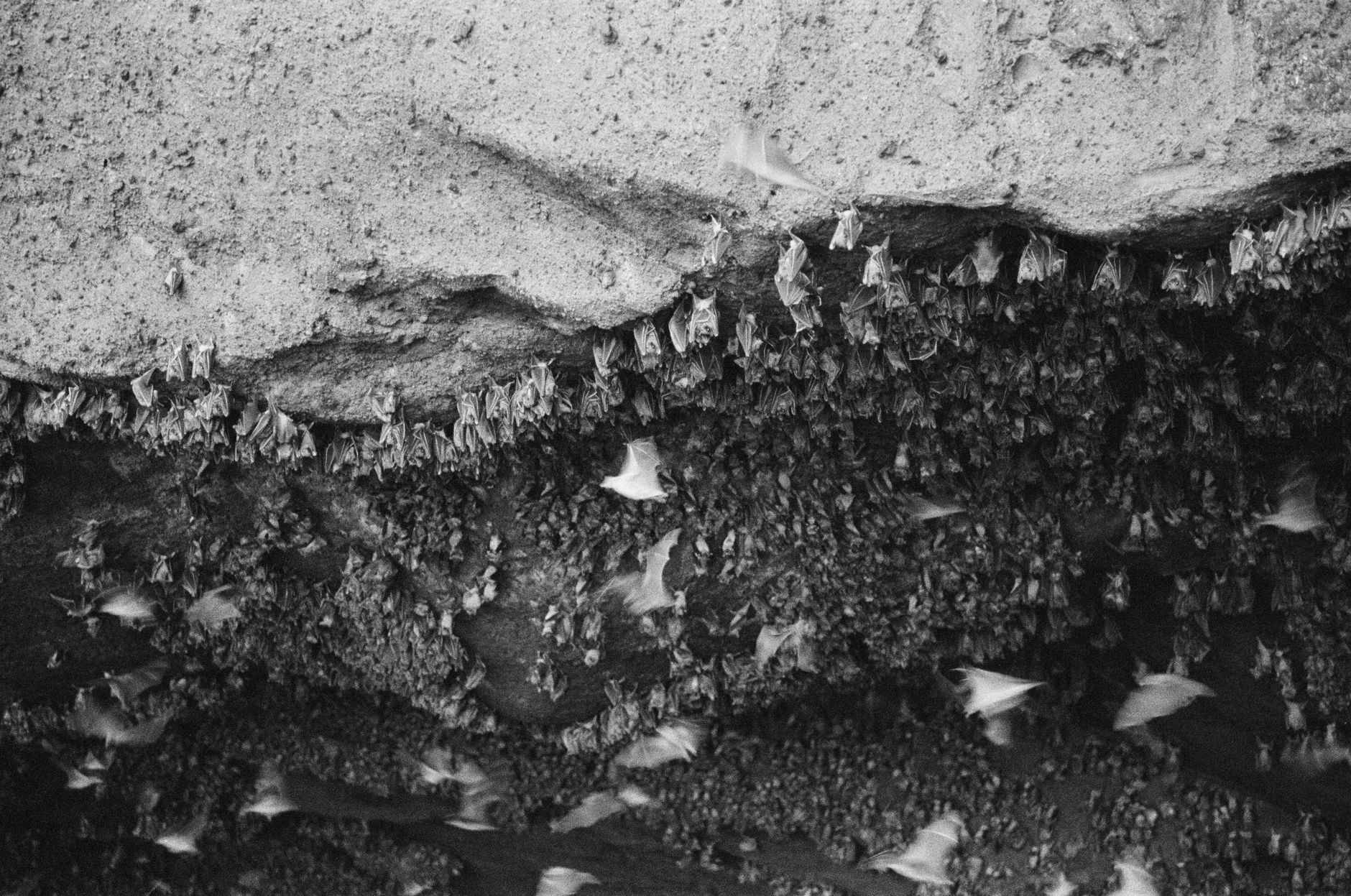
In Alberta's limestone caves, a biological rescue operation is underway as Parks Canada workers spread a probiotic bacteria blend in an attempt to save hibernating bats from a devastating fungal infection.
White-nose syndrome, caused by a fungus that grows in cold, damp environments like bat caves, is accelerating across the province and poses a catastrophic risk. The fungus appears as a fuzzy white growth on bats' snouts and wings and causes them to wake during hibernation, draining precious fat reserves they cannot replenish in winter — leading to starvation.
The fungus can kill as much as 98 per cent of a bat colony and poses no direct risk to humans, but its spread is alarming. Nina Veselka, a biologist with Parks Canada, has witnessed the devastation firsthand at a Jasper National Park cave where weakened bats have fallen from limestone walls.
"We could be looking at, like, local extinction," Veselka said of the cave.
In March, Veselka's ecological monitoring team counted nearly a dozen dead bats at the entrance of a hibernation cave in Jasper. By the time a full count was completed, the number had risen to about 69 — compared with just three deaths in each of the previous two years. Evidence of white-nose syndrome was found in three caves in the Rockies this year during provincial surveys and work by Wildlife Conservation Society Canada. The infection has also been detected in Alberta's largest known bat hibernation site at Cadomin.
To fight back, Parks Canada is applying bacterial probiotics at maternity roosts in Jasper and even inside some attic spaces where bat colonies have been confirmed. The treatment contains four bacterial strains proven to inhibit the growth of the fungus causing white-nose.
"It has four bacterial strains and they have been shown to inhibit the growth of the fungus that causes white nose," Veselka explained. The bacteria are applied where bats roost and transfer to their wings, tails, and faces to slow fungal growth — similar to applying hand sanitizer before touching a dirty surface.
In Alberta, probiotics are being used to treat the disease; in British Columbia, where the infection has not yet taken hold, they're being used preventively. The fungus first appeared in Europe in the early 1900s, where bats adapted. It arrived in North America two decades ago via New York and has since spread across the continent, killing millions. Alberta's first cases appeared in 2022.
Veselka counted 615 bats during March surveys, noting that populations in Alberta and the Rockies are small. Even bats that survive may be too few to huddle and stay warm or successfully reproduce. Still, the existence of a treatment offers hope.
"Knowing that there is something that we can do brings a little bit of hope because it's not just a lost cause," Veselka said.
