Fire service hasn't measured if East Van traffic barriers slow emergency response
Residents claim new traffic calming measures are delaying ambulances and fire trucks. The city consulted with emergency services during design. But Vancouver Fire Rescue hasn't actually measured response times.
The day's top stories, food & events — every morning at 7. Unsubscribe anytime.
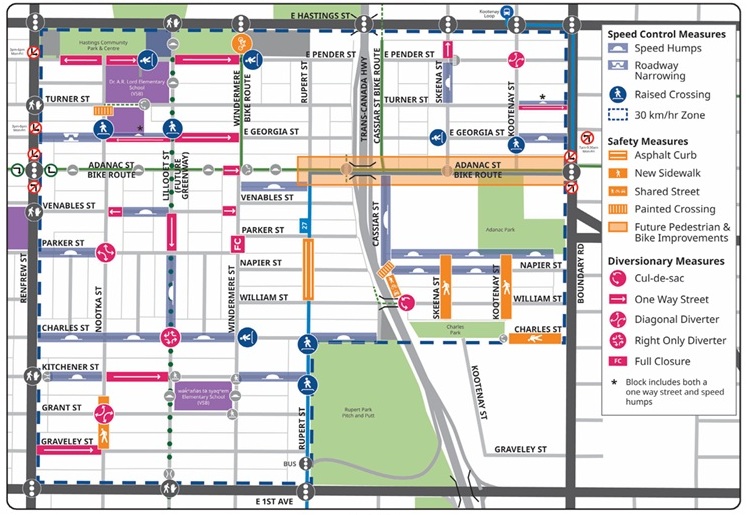
A group called the East Van Traffic Coalition is pushing back against traffic calming measures installed across the Hastings-Sunrise neighbourhood over the past two years, with the most disruptive measures installed this year. According to a Change.org petition the group says has passed 2,000 signatures, the concrete barriers, diverters and one-way streets are creating problems: the coalition says emergency vehicles are being delayed, traffic is being pushed into back lanes and school zones, and parking losses are hurting businesses on Windermere Street.
The coalition wants the measures removed from the area between 1st Avenue and Hastings Street, and from Nanaimo Street to Boundary Road. They're meeting weekly on Thursdays and plan to raise the issue with candidates ahead of the October 17 municipal election.
The City of Vancouver says these measures are part of the Hastings-Sunrise Traffic Calming Project, designed to address a decade-long resident concern about vehicles using the neighbourhood as a shortcut. The project was informed by two phases of public engagement in 2023, with a majority of survey respondents supporting it moving forward.
Implementation began in 2024 with speed humps and signage. One-way streets followed in January-February 2026, with remaining measures installed in May-June 2026. The City says the design was refined based on phase 2 feedback—a full closure on Skeena Street became one-way northbound, and one-ways were removed from Skeena, Cassiar and East Georgia to simplify access to homes.
On the emergency access question, the City says traffic patterns take several months to stabilise, so it will collect vehicle speed and volume data in fall 2026, with any adjustments planned for early 2027.
Vancouver Fire Rescue Services says it was consulted during the design phase and that emergency access requirements are built into the plan through the Vancouver Building By-law, BC Building Code, BC Fire Code and Vancouver Fire By-law. The service has not measured response times in the area. According to VFRS, "the absence of identified emergency access concerns following implementation" meant the measures "did not warrant a dedicated response-time analysis." The fire service is also not aware of systemic emergency access issues related to the project and has not formally reviewed crew reports specific to it.
The data that would settle the argument—from either the City or the fire service—doesn't exist yet.
The facts
When were one-way streets installed in the Hastings-Sunrise neighbourhood?
One-way streets were installed in January–February 2026 as part of the Hastings-Sunrise Traffic Calming Project.
Has Vancouver Fire Rescue Service measured response times since the traffic calming measures were installed?
No. Vancouver Fire Rescue Services has not measured response times in the area, saying the absence of identified emergency access concerns meant the measures did not warrant a dedicated response-time analysis.
When will the City of Vancouver collect data on vehicle speed and volume in the area?
The City of Vancouver plans to collect vehicle speed and volume data in fall 2026, with any adjustments to the traffic calming measures planned for early 2027.
